I recently watched “The Glenn Miller Story” for
probably the 19th time. Hollywood took significant liberties in bringing
the story of band leader and arranger Glenn Miller to the big screen. According
to his former band members, the real Glenn was not nearly as charming as Jimmy
Stewart, who played him in the movie. But I love the part where Glenn (Jimmy)
tries to describe the drive to create something new, to combine instruments in
a way no one has done before, and achieve a unified sound from the variety of
instruments and musicians playing them. I have this arranging bug. I’m not
happy unless I am arranging something: a tune for a saxophone quartet, a full
big band score, or a duet for two flutes.
When jazz started out it was mostly a small group
affair, with instrumentalists making up their parts and predominantly playing
by ear. As bands grew larger, this improvisatory approach became untenable, and
the role of the arranger increased in importance. All the great band leaders depended
on arrangers. As skilled as they were, many remained in obscurity, known only
to fellow musicians or the most ardent fans.
Arranging work can encompass a wide variety of
situations, from writing a “chart” for the Count Basie Orchestra, to scoring the
strings and brass for a furniture commercial. Almost every piece of music we
hear that involves more than a four-piece band requires input from an arranger.
Most arrangers played an instrument and often paid their dues as sidemen in
traveling bands. Pianist Mike Abene experienced the typical road travails and
additional instrument hassles that helped push him down the arranger’s path:
 |
| Michael Abene |
MR: What
was the road like at that time?
MA: My
big thing on the road was with Maynard [Ferguson]’s band. You know I didn’t go
through a lot of bands because I was so involved in the writing end of it. But
with Maynard at the time it was funny. It was like two station wagons and a
panel truck. And you’d have like basically — and it was a smaller band, it was
like four reeds, two trombones, four trumpets including Maynard, and three
rhythm. So you’d have usually the band boy and one driver would be driving the
panel truck and the rest of us would be split up into two station wagons.
Which, if you’ve ever ridden with five or six guys in a station wagon, six or eight
hundred miles, it’s not — so to this day I can sleep bolt upright — in a train
or car I can just sit bolt upright. It looks like I’m looking at you and I
could be asleep. But the thing is, it was funny with Maynard because I was
never really happy with any of the records first of all. And just the recording
quality, it was only one record I felt that the band really sounded good was a
thing called the “Blues Roar.” And we had enlarged the band at that, for that
particular — it’s Don Sebesky and I and Willie Maiden did the writing. But in
the clubs, when we’d do clubs or concerts, it was wonderful because Maynard
would just open up all the charts and we’d play like it was a small band. It
would just, I mean some tunes were like 45 minutes, 50 minutes, and the rhythm
section just used to be very loose. So if we could only capture that on record
I always felt. But I mean generally it was a good experience in that Maynard
was a very good band leader, sometimes a little too lenient you know, but he
was a great guy. I have no complaints about that. A lot of good things
happened.
MR: As
a piano player, did you ever have to deal with lousy pianos?
MA: God,
that’s why I prefer writing. You just answered — and you just solved the riddle
of my life. People say don’t you miss playing. Yeah I miss playing. But I
really love writing because, the first reason being that you know you guys can
play your own horns, like the drummer plays his drums, the bass player, but
then you’re stuck with some of these pianos, they’re just hideous. And to this
day that’s still kind of an occupational hazard for piano players too. But
that’s why, and the other thing is sometimes you play and you play a great
solo, right? So the next night you go back and nobody even has any idea about
how well you might have played the night before. It’s up in the air someplace.
At least you write something, a good band, it’s there to remind you if it’s
really good.
In all the interviews we’ve gathered for the Fillius
Jazz Archive, I have never once spoken to a successful musician who was forced
into the business. Mike Abene confirms that the path of a musician/arranger has
to be self-motivated.
MR: When
you were a teenager, did you have a choice in your career or were you compelled
to just go into music?
MA: I
was compelled, not through my parents, but self-compelled. And I realized very
young that I really wanted to be in music. And my whole family was basically in
music. My father was very good, like a Freddie Green kind of guitar player. He
had a big band, and his brothers all played. It was the Italian end so they
were all barbers and string players or [they played] accordions. His father was
an accordion player and mandolin and everything. And my mother’s side of the
family, her brothers, you know one brother was a drummer, another brother sang,
he married a woman who was a hell of a pianist, couldn’t read a note of music
but was one of those could hear something once and retentive, just bang, could
play it. So it was always around. But I really enjoyed — I was actually writing
and playing professionally at 15.
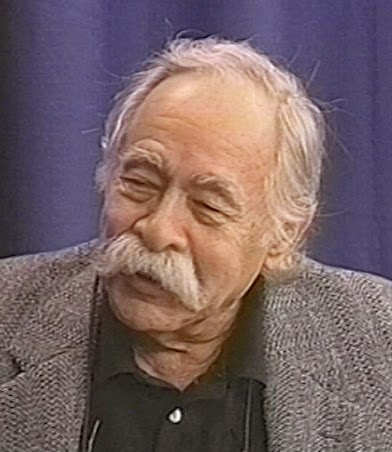
Manny Albam has arranged for an impressive list of
artists including Gerry Mulligan, Carmen McRae and Count Basie. As a saxophone
player, he avoided the instrument woes that Mike Abene had, and his physical location
in the band had an impact on his fledgling arranging career.
 |
| Manny Albam |
MR: Why
the saxophone as your instrument?
MA: It
started as the clarinet. I think I was about 13 or 14 and I guess I was
mesmerized by Goodman and Shaw. And Pee Wee Russell. Pee Wee was actually more
of a hero of mine than the other two guys, they were a little too glib and
smooth and all that. But Pee Wee had that essence of jazz. The rough tone and
the whole thing.
MR: His
personality was kind of interesting to watch too.
MA: Oh
yeah. I finally met him in Boston, we stayed at the same hotel and I ran into
him in the lobby and we talked a little bit. As a clarinet player I was almost
forced to take up the alto. And I started sitting into a lot of bands as a
second alto player. Now the second alto chair in those days, in the four-man
sax section was also baritone chair and so I became a baritone player and I’m
glad of it. I finally sold my alto. As a writer from the baritone chair you
hear everything up above you. You hear from your position way up to the first
trumpet and you hear right through all the chords and the voicings and all of
that. It’s a great place to live. And conversely, a lot of the arrangers, they
were trombone players and they sit right in the middle and they hear it from
both sides I guess. That’s where their thing is. You know, Brookmeyer, Billy
Byers, Ray Wright, a whole bunch of them, Don Sebesky, for some reason or
other, Nelson Riddle was a trombone player. It seems to be those two chairs are
great places to hear what other people do. So if you play other people’s
arrangements, you can learn a lot from them.
Like most arrangers, Manny Albam had to deal with a
rapidly changing music scene. His career spanned the swing era into rock &
roll and commercial work. Swing bands, and especially studio players, were
required to be excellent sight readers. Manny didn’t realize he had become
spoiled over the years by working with musicians who could play his
arrangements correctly, usually the first time. He had a rude awakening when he
started writing for rock groups.
MR: Did
it change your work at all when rock & roll became the popular music?
MA: Well
what happened to me a couple of times, there used to be a group in Canada
called the Guess Who, and there was another one called the Lloyds of London.
They would come down to New York and cut a basic track and then I would go in
and add strings and horns and whatever. And that began to become like a joke.
They’d go in, first the bass player would come in and play his line. And then
the guitar player came in and says, “wait a minute I can’t play with that
thing, you’ve got G natural and it’s wrong – I can’t do that.” So the bass
player would have to make another track. And then the piano player came in and
they’d change. So to get one thing down sometimes took three or four days.
Finally they got two tracks down and I took them home and I would write
“sweetening” is what they’d call it — strings and horns and all that. And we’d
call the session and the string players came in and sat down and they played
the thing through once and we recorded them the second time and they left and
then the horn players came in. And these guys were, “holy Jesus, you mean you
did the whole thing in 20 minutes? I can’t believe it.” I said, “well they’re
musicians. They read music.” You’d have like Marvin Stamm or Bill Watrous or
whatever. They’d just come in, sit down and go [scats] and leave, and pick up
their $90 or whatever. And the [rock] groups didn’t know then who they were
dealing with yet. They were dealing with great players.
Part of being a successful arranger is recognizing
what is needed for a particular artist. Bill Holman, who was capable of writing
thick and powerful charts for Stan Kenton, intuitively recognized the need for
space when he had his first assignment for a vocalist:
 |
| Bill Holman |
MR: You
had quite a list of singers here that you arranged for also. When was your
first experience doing a chart for a singer?
BH: It
must have been around the middle 50’s for Peggy Lee. I believe in starting at
the top you know. And I was really scared because I had kind of a crush on her
since 1942.
MR: Oh
that’s nice.
BH: But
she’s a great singer, so I really took it easy writing the charts. I didn’t put
a whole lot in there, you know, afraid to get in their way. She told me later
after a couple of years, she said, “the thing I really like about your charts
is all the stuff you leave out.” So I guessed right on that one.
Sometimes the biggest challenge in a “work for hire”
arranging assignment is the quality of the original content. During my
arranging/studio experience, the engineer had a phrase we used when we were
trying to rescue music that had no redeeming qualities: “putting frosting on a
turd.” Bill spoke honestly about his brief film scoring career:
BH: I’ve
never gone into actually composing for movies. I did a couple of grade C movies
in the ‘50’s.
MR: Did
you ever see them?
BH: Yes.
One of them made T.V. and it comes out occasionally as a re-run. It was called
“Swamp Women.”
MR: “Swamp
Women” with score by Bill Holman. Yeah?
BH: Yeah.
Terrible music.
MR: I’m
going to watch it.
Maria Schneider is one of the more recent arranging
success stories, and like Duke Ellington, found it a necessity to have her own
group to play her music. She is articulate and thoughtful in her teaching and
passing on what she has learned:
 |
| Maria Schneider |
MR: How
do you impart some of your
philosophies to other students? Is it possible to do that?
MS: I
try to just show them how I dance around and try to figure my way into music. I
try to encourage students to look for something that just feels good, then try
to find the logic in it, keep developing the logic, but kind of let their left
and right brain work together so that it doesn’t become too analytical. And
never thinking what do they think I should write, what’s going to be hip. What
should I adopt to be cool. But try to stay inside. I always feel like the thing
that makes each person unique is that you are you, nobody on earth can imitate
you, nobody can be more you than you are. So that your job is to become you to
the deepest degree that you can, and that’s where your beauty and that’s where
your mastery is, in developing yourself. I think so often it’s really easy to
look at other people and say oh he’s a master, I have to try to be like that, I
have to follow him. No, you have to find the depth of yourself and be
disciplined and develop yourself to the same degree that those people were
disciplined and developed themselves. And that’s the thing that nobody can
imitate. And that’s where your strength, and that’s where your gift is. That’s
what people want to see, is feel the uniqueness of each other. That’s where you
really communicate something fresh with somebody. It’s hard to do that.
Maria also believes that an artist cannot live in a
vacuum, that their work must be inspired by circumstances that come from living
a full and active life.
MS: Music
isn’t enough for me in life. There’s other things too. And I love music but I
think what I love about music is it’s a valve for other things. I love life,
and I want more time to live. And to me music is, one of the problems with
musicians is I think they get so caught up in making records and going to the
next project that very often the person’s first record is the most powerful.
Because that record represents years of just working on your own and doing
other things in life, and then suddenly you become so busy doing your music you
aren’t paying attention so much to the other things in your life because they
aren’t as important as the music. But what feeds the music? Music is fed by a
deep and rich life. So I think it’s really important to have other things in
your life that you can do with equal love.
Even with computer programs that enable arrangers and
composers to hear their work as it’s written, there is nothing like that first
“human read-through,” real musicians playing your work. It’s a challenge to
conduct with your fingers crossed.
My next entry will highlight some magnificent
arrangements from different musical genres.


 Posts
Posts

