Showing posts with label Frank Foster. Show all posts

May 3, 2016

The Basie Bus


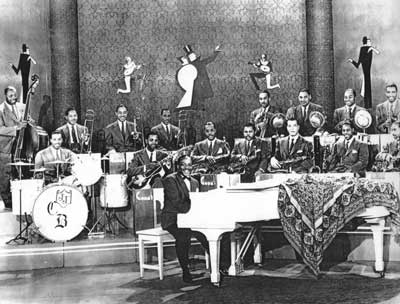
Imagine your job required you to ride an average of 190 miles before you begin your workday. At the end of your shift you travel another 190 miles, but you will not be home. Instead you will arrive at a second- or third-rate motel room to be shared with one or two other co-workers. This was basically the life of a sideman in the world-famous Count Basie Orchestra in its early iterations.
The Basie band was originally a Kansas City organization. In the mid-1930s William “Count” Basie took over the Benny Moten Orchestra after the death of its leader, and in 1936 they ventured out from this swinging Midwestern city. Some of their early engagements were relatively comfortable, with multiple weeks spent in one location. The Grand Terrace in Chicago and the Apollo and Famous Door in New York City hosted the Basie band and offered them an opportunity to hone their soon-to-be-distinctive sound. But these location gigs were not the norm. Author Chris Sheridan reconstructed a multi-year itinerary derived from band member diaries and the records of the William Alexander Booking Agency in Count Basie: A Bio-Discography. This fascinating book includes a travelogue that gives us an acute sense of the dues paid by big band musicians during the swing era.
In 1938 the Basie band played a week-long stint at the Savoy Ballroom in New York City. The following day they left on a tour of 46 one-nighters in 51 days. Here is the documented itinerary for one month of that journey. Beginning on March 19, 1938 in New York City, they traveled to Harrisburg PA, Wheeling WV, Akron OH, Lexington KY, Dayton OH, Huntington WV, Mt. Hope WV, Bluefield WV, Charleston WV, Louisville KY, Memphis TN, Birmingham AL, Chattanooga TN, Atlanta GA, Bowling Green KY, St. Louis MO, Kansas City MO, Omaha NE, Kansas City MO, Topeka KS, Wichita KS, Tulsa OK, Muskogee OK, Oklahoma City OK, Ft. Worth TX, Shreveport LA, and Waco TX. This totaled 5,154 miles or an average of 190 miles between gigs. The road trip continued with 19 additional one-nighters, ending with a 488-mile trip from Durham NC to New York City.
Established bands like Duke Ellington and Cab Calloway traveled by private Pullman railroad cars, but the early Basie band spent most of their waking hours either performing or riding on the bus. There are loyal Basie fans who insist that the personnel from this era was never equaled. Among the future jazz legends were trumpeter Harry “Sweets” Edison and the tenor saxophone duo of Lester Young and Herschel Evans. What would later be known as the All-American Rhythm Section consisted of Jo Jones on drums, Freddie Green on guitar, Walter Page on bass, and the Count on piano.
In the segregated society of 1938 America, black musicians were denied opportunities in classical and radio orchestras. What they could aspire to was a chair in an established, working ensemble. In the Fillius Archive interview from September of 1995, Sweets Edison recalled the necessity of this lifestyle:
Sweets Edison, in 1995
SE: There was no place for us to play but dance halls. I joined Count Basie in 1938 and he used to do like 300 one-nighters a year. Where Benny Goodman or one of those bands would be in a hotel six months in New York and the hotel in Chicago for three months, you know, they always were sitting some place where they could do balls or whatever they wanted to do. They could be with their families, you know? But we had to take to the road.
Fast forward 20 years, the band bus is upgraded and an occasional trip by air is called for, but the grind of the one-nighters remained the same. Tenor saxophonist Frank Foster was part of the 1950s “New Testament” Basie ensemble, and in his 1998 interview he reminisced about life on the road, and how it was taking a toll on his family life:
MR: The decision to leave Basie — was it just the length of time you were there?
Frank Foster, in 1998
FF: It was a number of things, mostly I had a family that was growing, I had two children in my first marriage, and not being able to stay home more than a few weeks at a time, I was not able to really watch my kids grow up. And then gradually the audiences changed. I guess these people died off or something, and the audiences became mostly families, like people, maybe one guy, he loves the band, he brings his whole family, his wife and his sister and her husband and their children. And not everybody is feeling the way he’s feeling about it. And it got to appear as though a lot of people were coming just out of curiosity, like well let’s go see what this Basie band is about, I’ve been hearing about them, let’s see what they are. Oh, they’re not The Beatles. Oh, they don’t play rock & roll.
MR: Well you anticipated my question. I wondered if that was what was causing it, was the rock & roll.
FF: I think the advent of rock & roll and how the big beat just inundated the world, and I think that just kind of put a damper on things. The crowds, the big band groupies disappeared in the early, mid, late 50s we had big band groupies by the busloads. And that was all off. But it wasn’t so much that as the nature of the audiences was changing and it didn’t appear that everyone there was a devout jazz lover and a devout Basie lover. And so trips to Europe got to be not so exciting. And sometimes accommodations were a little touch and go. And I began to get tired of the bus. We began to become weary of smelling each other’s armpits.
MR: Basically living with each other all the time.
FF: Yeah. Basically living with each other all the time. And some guys who came to the band couldn’t get along with guys who were already there and there were a couple of even fist fights, and all manner of things that were making road life not as glamorous and as fun and as happy as it had been. The novelty had worn off and I had gotten involved in so many different kinds of undesirable affairs and personal life was just in a shambles. And I wanted to be closer to these children. So all these influences. And plus, oh the big thing was I wasn’t getting to play enough.
Young musicians of every era can read these stories, and even if they hear them first-hand from those who lived it, they still decide for themselves that they want to do it, and eagerly inquire, “When does the bus leave?”

March 11, 2015

Lew Soloff, 1944-2015


On the heels of the death of Clark Terry, we now mourn the passing of another trumpet legend. Lew Soloff passed away on Sunday, March 8, at the too early age of 71. I was enrolled in the music program at SUNY Fredonia in the late 1960s, and Blood Sweat & Tears LPs were constantly on our turntables. For us it was a musical triumph to have trumpets, saxophones and trombones share equal space with electric guitars. Lew Soloff was responsible for the virtuosic solos that helped BS&T score number one hits.
Lew was a jazz man at heart, and while he enjoyed the notoriety of playing in a band that celebrated rock, his tenure with BS&T was a small part of his career. He was a member of an elite group of instrumentalists who could excel in any musical situation. Although his resume included playing behind Frank Sinatra, Barbra Streisand, Sting, and Billy Joel, his driving passion was to improvise. One of his proudest accomplishments was his recordings with the Manhattan Jazz Quintet, which he co-founded.
Frank Foster
Unsolicited praise is the best kind, and in 1998 Frank Foster addressed the subject of race and jazz and when he wanted to cite a white musician at the top of his game, he spoke about Lew.
FF:    Are you familiar with Lew Soloff? Lew Soloff can play anything, can play jazz, can play lead trumpet, he can play in a section, you know, he can just do anything that’s necessary for a jazz trumpeter to do. Big band, small group, whatever.
Lew described the difference between being very good at what you do, and exceptional.
LS:    It takes a lot to concentrate and to be a master, a real master, or to try to be a master of one thing. It’s basically a different thing of being a working trumpet player, which means hello, sure, sub over here tonight, yeah? Wedding tomorrow night? Sure. Okay, a block party? Fine. A jingle here, you know, a recording date. There’s one thing to being a working trumpet player, and it’s great and it feels really good to be called for that kind of work. But it’s another thing to be a working musical personality, where people hire you because of the way you play, not because of the way you play the trumpet, but because of the way you play. Because of the way you can play a song. Because they like your style. The first person who made me aware of it very clearly was Warren Vaché actually, who I’m a great admirer of. And I was telling him — this was years ago and I was doing a lot of studio work — and I said, “gee I really want to get better at playing jazz” and this and that. “Well, look,” he says, “it’s kind of hard to do when you play the way everybody else wants you to all the time.” Gil Evans of course would state it as it’s basically hard to be creative when you have to be professional.
Having music as your main source of income is a dicey affair. Frank Foster described it as “freelance starving.” Nonetheless, my classmates and I aspired to it, and Lew Soloff was one of the best examples of where we wanted to be. He spoke eloquently about the passion and the strong sense of direction that aspiring musicians had to have:
MR:    Have any words of advice for young trumpet players or musicians trying to break into the business these days?
LS:    Yeah. I do. First of all you have to decide what you want to do, whether you want to be an instrumentalist, a trumpet player per se, or whether or not you have a love of jazz to the point where you want to be a stylist. You have to decide what you want to do. If you want to be an in-demand cat, and I include women in that, to play any kind of job for anybody, the key is versatility and very fast sight reading ability. There are people that learn to read lines ahead of where they’re playing. Very few people have this ability but some people do, culminating in maybe a whole page ahead, almost like photographing the page with your mind. But most people that can do that learn it when they were very small. But it’s a good thing to learn to read, if possible, a bar or two ahead, or even more if possible, then where you’re playing. It’s a skill that’s hard to develop, I don’t have it, I read maybe a couple of beats ahead of where I’m playing. But if you can do that, if you can become a superb sight reader, if you want to become a horn for hire or a musician for hire, that’s one of the prime things you need to do. And there’s another kind of musician who could be a for-hire musician as a sideman, and I think this combines with being a stylist, where you may not have to read as well but you still have to be a good reader if you’re going to play in somebody else’s band. Because somebody else wants to do new material, and if the whole band can learn the material in two hours and you need to spend four days learning it because you can’t read, if there’s another person plays as well as you they’re going to get the job. On the other hand if you’re such a super excellent player that somebody wants your feeling on it, you’ll get the job even if you’re a slow reader. But that’s rare. It exists, but rare. And then, if you’re hooked on music and you want to really express yourself playing your music you should start getting bands together, ensembles together, whatever it is you like to play and you should start assuming the role of leadership at a young age and learn how to play your own music, in your own group, and how to get a whole concept of what you like. Develop your whole concept of what you like and go for it. Don’t have any doubts about it. And the final piece of advice is that it’s a very competitive field, everybody would like to have a good time rather than go to work and do a job they don’t like from nine to five. So if you love it enough and you really want to do it, work really, really hard at it. And if you don’t have the ability to work hard at it, it’s going to be a very dangerous field for you to make a living. There’s no guarantee of making a good living anyway in it, because it fluctuates. But, in other words, the passion has to overcome all the possible problems. It’s very possible to make a great living at it also. But the passion has to overcome all these problems. It has to become more important than a comfortable (meaning rich) lifestyle. It has to be more important to you than that, and then you might get the rich lifestyle from it.
MR:    That’s great advice.
LS:     Otherwise don’t go into it.
For two additional Jazz Backstory blog entries that featured Lew with Blood, Sweat & Tears, you might enjoy Spinning Notes from 6/19/14, and Inside the Studios Part IV from 9/1/14.

July 28, 2013

Global Channels


An argument can be made that everything comes from someplace else. Even jazz, frequently extolled as “America’s only original art form,” is a blend of disparate styles blended together into something new. British pianist Keith Ingham came to America to pursue a career in jazz, and described this unique blend with great passion:

MR:    Are there any counterparts of American musicians who’ve gone over to England and learned as much about your music as you have about —
Keith Ingham
KI:   What do you mean, the British music? I mean we never had anything as wonderful as jazz. You see, I think it comes from a melting pot society where you’ve got all these different strains coming together. That’s the whole point. You had Italians here, so you have these wonderful lyric qualities; you have African-Americans, that rhythmic thing they do they brought that looseness and that sense of swing; you had the Germans here so you have the correctness of intonation and things like that. You have that whole melting pot. And they all brought their music. You have the Russians with all that minor key, soul stuff. It’s wonderful. Gershwin is Russian but also very Jewish and that kind of sad, soulful feeling that’s in his music. It’s the melting pot that America is that made American music. That’s what it is. There’s nothing like it in the world. You’re so lucky, don’t lose it, because it’s your great contribution to world culture. I mean it’s your Beethoven, your Haydn, your Schubert, your Debussy, your Ravel, your Rachmaninoff, your Stravinsky, it’s all there. It’s Duke Ellington, it’s Fats Waller, it’s Henry “Red” Allen, it’s Bix, it’s Eddie Lang, it’s Joe Venuti, it’s up there. And God bless it.
Saxophonist and arranger Frank Foster expressed it succinctly: “we have such a melting pot here, we’re all into each other’s culture.”
Until the early part of the twentieth century, America’s music, dance and visual arts were mostly based on European styles. The cultural tables have turned in major fashion as we now identify music as America’s most significant export. It’s a shame that America can’t be compensated financially. If we could charge for the export of our creative innovations, our trade imbalance would immediately be in the black. Musically the world is now hard-wired. National and geographical borders are meaningless as musical genres spread globally via the internet.
It’s no secret that America’s musical seeds have been spread around the globe and found fertile ground. European musicians jumped on the jazz bandwagon as early as the 1920’s. The Beatles and the Rolling Stones learned their lessons well from American blues and rock & roll, and sent it back to us, new and improved.
I got my first taste of the pervasive effect of American popular music some years ago when I played a gig for a Korean fraternity at Colgate University in Upstate New York. On our break a student asked if he could play their music through our PA system. I obliged, and in my naïveté expected to hear something exotic and different, perhaps flute-based pentatonic melodies with some twangy plucked sound from an unknown instrument. What I heard was American-based pop music, rhythms, forms and instrumentation, with Korean lyrics. More recently I became acquainted with a Hamilton College student who had traveled to the college from Kenya. In getting to know him, I asked some basic questions about his home and surroundings. I was curious about the kind of music popular in his hometown. His answer was “Kenny Rogers.” Kenny Rogers!? And even in the last month, the evidence mounts. I recently played a lunchtime gig at a Chinese restaurant, run by immigrants from China. The presence of a saxophone player in the group prompted one of the young waiters to ask me “does the sax player know the song ‘Go Home’?” “Go Home?” I asked. “Come Home” he stumbled with his English. Then a vague memory surfaced. I think Kenny G had such a song. I said, “do you mean ‘Going Home’?” He said, “oh yes, Kenny G, Kenny G ‘Going Home’. Kenny G is very big in China.” Nelson Mandela has survived to recently see his 95th birthday. Outside the hospital his well-wishers sang to him, first in their Sotho dialect, then in the Dutch-based Afrikaans, and finally in English. The melody? But of course, “Happy Birthday,” written by two American nursery school teachers.
I am currently seeking to collaborate with musicians from Utica’s refugee population, especially those from countries in southeast Asia. In attending their cultural presentations I am hearing more of the same. The singers are being accompanied by play-along tapes that could just as easily be accompaniment for Justin Bieber.
But it’s not a one-way street. American musicians embrace influences from around the globe: Latin jazz, Celtic rock, and other combinations now are common concert fare, and many bands tout their ability to combine exotic styles.
Academia has also played a major role in exposing and presenting music from other continents. I recently attended a summer concert at the Eastman School of Music, one of the most prestigious conservatories in the country. On the bill was music from Indonesia in the form of a Gamelan Angklung (ensemble), an Mbira orchestra playing music from Zimbabwe, and a Pan-African percussion and dance ensemble led by Kerfala (“Fana”) Bangoura. It was a fascinating evening of music, with sounds and sights that were a first for many in the audience. As with our home-grown jazz and blues, America has now taken traditional music from other countries and placed it in academic and concert settings. It was informative to view the members of the Gamelon and Mbira ensembles, an all-encompassing cross section of gender and generations, all of them energetic and committed to the performance of this music from the other side of the globe, and all of them from Central New York.
Fana Bangoura
Only the African percussion and dance ensemble included members who can claim their performance as part of their native culture. Fana, the leader, was a longtime member of Guinea’s prestigious “Les Ballets Africans and Les Percussions Des Guinee” national performing group. A number of his members include djembe players from other West African countries, and the rest of his ensemble is made up of interested Rochester residents. I am happy to say that my own daughter held down an incredible anchoring pulse on a trio of drums known as the dun dun. Calling this music polyrhythmic would be a understatement. I’m sure everyone in the audience experienced a dramatic increase in their pulse and blood pressure as the six djembe players added to the groove of the dun dun, and Fana improvised over the top of it, like our finest jazz artists. The dancers in their native garb added a further rhythmic and visual component. There’s something primal, intoxicating and magnetic about the sound of drums. The wood and animal skin are made to come alive with the energy of human hands, triggering a visceral excitement, no matter where you are on the globe.
Our friend Dave Brubeck knew it. He said “rhythm is the universal human language.”

February 19, 2012

The Color of Jazz

The Benny Goodman Quartet

Our interview strategy for the Hamilton Jazz Archive was without an explicit agenda. We hoped to provide a comfortable venue for musicians to share recollections and opinions formed from a life in music. It became clear early on that certain topics appeared frequently. These themes included life on the road, learning to play jazz on the bandstand, improvisation, swing, and the role of race in jazz. It is this last topic on which I would now like to shine a spotlight.

I like to think that race does not matter in jazz, or at least that we have outgrown the time when it did, and that the world of jazz is now as democratic as the music, by definition, has always been. I also would like to believe that race does not matter in politics, sports, obtaining an education or in any aspect of American life. Or, in the sunny optimism of singer Jon Hendricks, “So when somebody asks me about race, I say what time does it start?” For Mr. Hendricks, the word “race” indicates someone or something moving quickly around an oval-shaped track. As we will see later in a more complete quote, Jon Hendricks refuses to recognize a racial problem exists. While I have the utmost respect for Mr. Hendricks’ outlook, eloquence and humor, I fear that it is not reality and probably never will be.

Nevertheless I am heartened by the message voiced repeatedly by many artists interviewed for the Archive. Their stories inform of us of the racial inequities that accompanied bands in their cross country tours, the ludicrous situations with venues, restaurants and hotels, and the social mores of the time that were enforced by peacekeepers and bean counters. But the stories also put forth a unified message that once musicians make it to the stage and studio, talent and personality trump age, gender and race.

Jazz musicians and band leaders were not immune to whatever racial inequalities and restrictions were in place. These impositions varied from one decade to the next and from one region of the country to another. Making a living as an entertainer could be an adventure in more ways than one. Interviewees shared some of their stories about incidents that happened before one note was played.

The most beloved couple in jazz have to have been Milt and Mona Hinton. Milt “The Judge” Hinton played bass on thousands of recordings, circled the globe with Louis Armstrong and Cab Calloway, and blessed us with photographs of his fellow musicians that only an insider could have taken. Mona and Milt opened their door and hearts to countless musicians and could invariably be found at the center of a circle of friends and admirers. Mona Hinton accompanied Milt in tours with the Cab Calloway band in the 1930’s and spoke of those travels in this interview conducted in March 1995:

MH: Well, unfortunately, due to the climate of our society, the blacks and the whites were segregated. And it made it very difficult, especially when we were traveling in the south. Because frequently we would run into Glenn Miller’s band or Tommy Dorsey’s band, or some of the well known white bands. They were staying in nice hotels. And unfortunately the black musician would have to stay on the other side of the tracks, usually in someone’s home, or in a hotel that was not very good. And as I say unfortunately, frequently the owners of the hotels, they would take advantage I mean of the black musicians. They knew that we could not stay in places, and we’d run into places with rats and with the roaches and with the bed bugs and whatnot. So under those circumstances it was not good. Frequently we would go in towns and I would have to go out in the black community and try to help find rooms for the musicians in Calloway’s band, and sometimes it was very, very — the places where we had to eat were just intolerable. And as I say, we made it.

Both Cab Calloway and Duke Ellington often solved this problem by hiring their own Pullman cars enabling the bands to travel, sleep and eat on their own terms. When confronted with such slights, Duke was known to say, “no one is going to make me change my pretty ways.”

Sometimes just arriving at the gig could present an obstacle. Trumpeter Joe Wilder was a member of the Lucky Millinder Orchestra in 1947. Like Milt Hinton, Joe Wilder emotes a sense of dignity and class with a wry sense of humor that served him well throughout his career. I asked Joe about touring the south with Lucky’s group in this interview from October 1998:

JW: We were in South Carolina [with] Lucky Millinder. Lucky was a very nice fellow. He was not a musician, but he had a lot of natural talent for selecting the right kinds of tunes and tempos and things of that nature. But we had — I think six of the members of the band were white. And we arrived early in South Carolina at this hall where we were going to play, and suddenly up drove the sheriff with his deputy in the police car, and he says “who’s in charge here?” And so Lucky said “I am.” He said “well I’m just here to tell you there’s not going to be any mixed bands playing down here in Charleston.” And Lucky looked at this guy, and Lucky — you know the reason I think they called him Lucky, he would take a chance on anything — he looked this guy dead in the eye and said “this is not a mixed band.” And some of the guys were blonde with blue eyes you know, there was no way in the world anybody would have mistaken any of these guys for being blacks you know. And so he went to each guy. I think if he had said “are you black?” he might have gotten a different answer. But he went to each of these guys and asked, he said “are you colored?” And each of the guys, going along with what Lucky had said, would say yes. And so he would shake his head. And finally the last of the guys he asked was Porky Cohen, who was our first trombone player. And he had a slight lisp. And when he asked him, now Porky is responding more emphatically than the other guys, and he said “why thertainly” with this lisp. And at this point we had all been starting to chew on our tongues and everything, trying not to break up because it was so ludicrous. And you could see the ground tremble, we were trying not to let the sheriff see it. But anyway he turned to the deputy and he said “well I guess if they all say they’re colored, there ain’t nothing we can do about it, is there, Jeff?” And so he said “no sheriff.” And they got in the car and drove off. And we played that dance that night. It was very funny. And it might, as I mentioned to you, it might have been the first time that an integrated band played there. It’s very possible that that was the first time.

Despite the best efforts of law enforcement and promoters, the music had a way of overriding the rules, both written and understood. Vocalist Ruth Brown made her mark in jazz, blues and R&B. As a band leader, she experienced her share of troubles on the road. Arriving at the gig did not mean those situations had ended for the night. In March 1995, Ruth related what a typical gig could be like:

RB: Well most times we worked warehouses and barns, and nine times out of ten that didn’t have what you call the “second balcony.” If we were lucky to play a county hall or an auditorium sometimes, they had a balcony, and in that balcony was called the spectators. These were the whites who bought tickets to come in to hear the music but were not allowed to come on the dance floor. Sometimes it was vice versa. The whites would be down and the blacks would be up in the balcony and not allowed to come down. But in places such as barns, warehouses, where there was just one level, they would separate the races with a rope, and I say, a clothesline was what it was, an oversized clothesline. And most times someone had taken a huge cardboard and written “Colored” which was the definition of our ethnic group at that particular time, and on the other side the card would say “white.” And the white spectators were allowed to dance on that side of the rope, and the black on this side. But what they did not anticipate was that the music generated such a joy, people got to dancing, the ropes would fall down, I seen it happen many times. And people would continue to dance, and just wander in to each other’s space. Nobody would say a thing for a moment, and then it would occur to some official that, uh oh, the rope is down and they’re dancing in the same space, and we can’t have that. And then somebody would run up on the stage and say “stop the music” you know and they’d just stop the music and go back and put the rope in place, and you had to go back on your given side.

Ruth and her band were once pulled over for going five miles over the speed limit. Suspicious because of the high priced car they were in, the troopers made the band prove they were musicians by getting their instruments out and playing on the side of the road.

The race card could be dealt both ways as drummer Louis Bellson learned. He was the only white player in Duke Ellington’s Orchestra in the early 1950’s and was once asked to become “non-white” so the band could keep him on stage. His quiet manner only gave more weight to the wisdom of his words when I met with him in April of 1996:

LB: In 1951 they had the Big Show of 1951, which consisted of Nat King Cole, Sarah Vaughan and Duke Ellington’s band. They were the three big stars. Now besides that they had Peg Leg Bates, Timmy Rodgers, Stump and Stumpy, Patterson and Jackson, all these wonderful acts — tap dancing acts. It took us a week to rehearse that show, playing with Nat King Cole and Sarah, Duke, and all these acts. So after we finished rehearsing for a week, Duke finally discovered that hey, we’re getting ready to go down to the deep south you know? And in those days, you had segregated audiences. The whites couldn’t play with the blacks at that time you see. In those days it was “colored,” you didn’t use the word “blacks” see? So now the big problem is, Duke called me in the dressing room and says “what are we going to do? I can’t find a drummer to take your place, because it would be a week’s rehearsal and the guys that can do it, they’re all busy.” So Duke says “you mind being a Haitian?” I said “no, okay, that’s all right” you know. So we got through it okay. It was a little tense, because the situation was still down there, and the audience, because they told Jack Costanzo with Nat King Cole he couldn’t appear because of the racial thing you know. But some spots it was a little rough you know. But we got through it. I think through Ellington’s peaceful ways and the wonderful attitude that the band had kind of rubbed off on everybody. But still it existed.

MR: Well it’s nice that the music had a part in helping that situation to move along a little faster I guess.

LB: Well we played a gig in Mississippi and there the townspeople were wonderful, they came to the rescue, where we couldn’t stay in certain hotels and so forth. I mean these people came from wealthy families too. They had Strayhorn and Duke and Clark Terry stay in one house, and Carney and Russell Procope and myself in another house, and all on down the line. Beautiful homes and they fed us. So along with the bad there’s some good too. And these were situations that we got over, we dealt with it. Sometimes it’s almost like a slap in the face but you realize what the situation is and you go straight ahead because you’ve got something to do that’s valued and I think when you do that you realize that none of those things should bother the musicality of something. It’s the fact that whoever’s playing that music doesn’t make a difference, let’s play it and show where the peace and love is.

Trumpeter Red Rodney pulled off a similar ruse when he became an “Albino Red” for his southern tour with the Charlie Parker Quintet.

In the 1930’s, when big band jazz was the popular music of the day, an important breakthrough occurred. Pianist Teddy Wilson often played intermission piano between sets of the Benny Goodman Orchestra. Because he was black, he left the stage when Goodman’s musicians entered. At the urging of jazz promoter Helen Dance and despite warnings from his management, Benny Goodman thwarted convention and hired Teddy Wilson and Lionel Hampton to perform with his band. With drummer Gene Krupa, this quartet become one of the most recorded small groups of the decade. Jackie Robinson’s entry into major league baseball nine years later drew more press, but Lionel Hampton and Jon Hendricks both touted Goodman’s integrated quartet in their interviews, conducted back to back on October 18, 1995:

LH: I was the first black musician to play in a white band. See and Teddy Wilson was playing with Benny, but he used to play when Benny used to take intermission, and no white musicians was on stage, then Teddy would play, by himself see? So I was the first one, legally, to break that tradition down. But you know the funny thing about it, there wasn’t no black and white playing together no place. Not in pictures, moving pictures, not in baseball, or football, no kind of sports. The Benny Goodman Quartet was the first mixed group and we were the first integrated group, the first black and white group.

MR: Was that ever a problem playing in certain parts of the country?

LH: No, no. Because we all played good music. And Benny presented us in a professional way. We were four in his organization, and it would be noticeable that we were soft. And the people liked that. Some of the ovations that he used to get, it was the sound.

MR: Jazz especially was so important in breaking some of the racial problems down.

JH: Absolutely. Benny Goodman is an American social hero. He is a hero in the development of American society. Outside of music, Benny Goodman is a social hero. Because his love for the music was so pure that he just did not understand why he couldn’t have Lionel Hampton in his band, and then Charlie Christian and then Teddy Wilson you know. He just didn’t understand that. And the bean counters and the accountants and the lawyers, they tried to explain to him, “Benny, you’ll lose your show, they will not renew you on the ‘Camel Caravan’ if you do this.” So they gave him all those very hard and fast business reasons. But he refused to understand it. He said “I like those guys.”

MR: They play the music I want, so they stay, right?

JH: So he did what people have to march now to achieve. And it’s because of the power of the music, a love of the music.

Eventually the integration achieved on stage found its way into the New York City recording studios in the person of Milt Hinton. At a record date, every studio musician had to prove they could get it right the first time, could handle any kind of music placed on the stand and be punctual and versatile. In the studio, ability is color blind. In his book Bass Line Milt relates how a chance meeting with Jackie Gleason helped make this happen for him:

MH: It was during my slow period that I ran into Jackie and his manager, Bullets Durgon, on a street corner downtown. He asked me the usual kind of questions, “Whatta ya doing? What’s going on?” Instead of giving him the standard show business answer I said, “Nothing.” Jackie turns to Bullet and said, “We’re doing a record date tomorrow, put Milt on it.” Bullets tried to explain about contractors but Jackie didn’t want to know. “I don’t give a damn about contractors. Call whoever is in charge and tell him I want Milt there tomorrow.” The next morning I showed up at Capitol. There must have been 50 musicians in the studio. I’d recorded before but never anything this size. Besides, I knew from the minute I walked in, I was the only black. After the first few takes, we took a break and a couple of the musicians came over and introduced themselves. By the time the date ended I felt much more comfortable. The contractor came over, complimented me, and asked if I’d do the next session to finish the album. I didn’t even wait to get the date and time — I just nodded yes.

After all the societal hang ups are acknowledged and stories are told, the question of ability finally arrives. The comments and anecdotes I listened to in these interviews on this subject seemed genuine and heartfelt. The experiences and influences that set these musicians on the jazz path ran the gamut from the church they attended as a child to what station the radio in the house was tuned into at night. To these artists, qualifying a jazz musician’s success by adding or subtracting points because of their race would be an insult. By championing the ultimate importance of the individual, these musicians bolster their own accomplishments and give us a reason to take faith in the power of the art form. Early in the project, I admit to feeling ill at ease bringing up the question of jazz and race. I soon understood that it was okay to talk about it and that there was nothing awkward about the subject that these men and women had not lived through and had long ago drawn their own conclusions.

Selecting the “best” quotes from the rich material in the archive collection is an exercise in futility but I have settled on one from a musician who’s career included being a bandmate and a leader and who shared the stage with both the first and the current generation of jazz musicians. Saxophonist Frank Foster visited Hamilton College as an artist-in-residence after stepping down as leader of the Count Basie Orchestra. He shared these thoughts with me in April of 1998:

FF: I don’t think every person born into this world is a jazz musician, and I don’t agree with — somebody’s got something out that says anybody, everybody can improvise. I don’t go with that.

MR: Oh that’s right, there’s a series, Anybody Can Improvise.

FF: Yeah. I don’t subscribe to that. But it’s an individual thing, it’s not a racial thing. We have such a melting pot here, we’re all into each other’s culture. Okay, I contend that jazz was born in America as a result of the black experience. Now nobody in the world could ever convince me that that isn’t true, okay? But now as I said before, we’ve got this melting pot where we’re all into each other’s culture. We can emulate one another, and we can relate to one another, and talent wasn’t just given to whites or blacks or Latinos or Asiatics or whatever. Every racial ethnic group has talent. And all God’s children got rhythm, some more than others. Look man, I know some black folks who can’t clap on two and four. One-two-three-four. ONE-two-THREE-four. I know some cats who can’t do this [claps]. On the other hand I know some white folks, every time will say [claps] and vice versa you know. So we’ve all got talented people and we’ve all got some no-talented people. Every ethnic and racial group has somebody blowing a horn that should put it down and forget it and be a plumber or a postman or something. But when I hear somebody who’s not black perform on an instrument and that person is good, they are good, regardless of what somebody else black might say — oh he can’t play, she can’t play, that’s it. Man, it hurt me years ago, one of my trumpet players, are you familiar with Lew Soloff? Well this guy just put Lew Soloff in the garbage can, “he can’t play, he never could.” And Lew Soloff is a monster. Lew Soloff can play anything, can play jazz, can play lead trumpet, he can play in a section, you know, he can just do anything that’s necessary for a jazz trumpeter to do. Big band, small group, whatever. So when one of us can do it, give us the credit. When one of them can do it, give them the credit. I don’t feel threatened by anybody. If you can play and you’re white, great, let’s play together. If you can’t play and you’re white —

MR: Go play with someone else.

FF: Yeah. If you can’t play and you’re black, get out of here.

Frank’s comments remind me of my own feelings about playing music when I had the good fortune to play a series of gigs in 1998 with Claude “Fiddler” Williams. If you had attended one of our performances you would have seen then 20-year-old blond bassist Genevieve Rose swinging next to “The Fiddler,” who toured with the Terrance Holder Band in Oklahoma in 1928. Claude and Genevieve were bookended by two middle aged white guys, Syracuse guitarist Mark Copani and yours truly. The dynamic quartet was the perfect blending of musical and cultural elements, and musically one of the most satisfying of my career. Or as Louis Armstrong summed it up, “There are good cats and bad cats of all hues.”

Earlier I alluded to the wit and wisdom of Jon Hendricks. He is an artist worth studying, either in the recordings of Lambert, Hendricks and Ross or with his own recent releases. In our second interview in January of 2000, he talked about his father (a member of the clergy), his hometown, and the big picture:

JH: My father had an aura and an authority about him that people immediately respected. When he died, by that time I had married an Irish girl. When he died I took my wife to the funeral. And when I drove into town the town was buzzing, because it was in Kentucky. And they stopped me a couple of times and says “whatchall doin’ here boy?” And they’re looking at my wife. And I says “I’m Jon Hendricks, I’m here for my father’s funeral, Reverend Hendricks.” And they said “oh Reverend Hendricks, okay.” And I went to the funeral. It was incredible. And at the funeral, half the town was there, and fully half of the people in the church were white people. That’s how respected my father was. And I remember sitting with him one night and there was a local white preacher who used to come over in the evenings and sit and talk to my father. They would be sitting in these rocking chairs on the porch. And one night the preacher says “Reverend I just wanted to discuss something with you.” And my father says “what was that?” He said “well I just can’t help it,” he said, “I just feel that my people are better than your people.” And the rocking kept on, and I’m waiting. And my father said “well Reverend,” he said “do you believe in God?” And so the white preacher said “well you know I do.” And my father said “well then what’s your problem?” And the rocking kept on. And not another word was spoken. And I said whooooh. He got right to the heart of the matter. Because that’s the key. We still talk about a problem. There is no problem. There is no racial problem if you acknowledge God. Because if you acknowledge God then you are looking at another child of God. So what are you talking about? If you’re going to separate from that other child of God because of this mythical term you have here, you are acting in an ungodly way. So when people ask me about race, I say “what time does it start?”

At jazz conventions and festivals we witness the current jazz melting pot. Thousands of musicians, educators, students, promoters, producers and publicists of every race, age and gender converge in the name of jazz. Many of them hope to grab a piece of the small pie that jazz — now officially recognized as an art form — occupies in the music market. It is an uphill battle, but as in any artistic endeavor, originality and skill will earn the spotlight.

Societal shifts often occur imperceptibly. Music frequently serves as a catalyst for social change. The sentiments expressed by these interviewees are now being evidenced in the political arena, where the ability to compete is now unencumbered by ethnicity or gender. Talent wins the race.


July 24, 2011

Tales of the Big Bands: Basie, Part 1


For many fans of big band music, the Count Basie Orchestra was the epitome of what an 18-person ensemble could and should sound like. Throughout his five decade career, Basie (a/k/a “The Chief”), held tight to his inner compass of what and how his bands should play. Though he was a man of few words, he made his feelings and intentions known through subtle but forceful direction. The Hamilton College Jazz Archive oral history project focused first on Basie alums and we are blessed with a wealth of material about Count Basie and his career. The first entry will focus on why his band sounded like it did.

We heard from Clark Terry in his conversation with Joe Williams at the end of our Ellington blog post. Clark spent time with both bands, and offers his opinion on Basie’s number one strength:


CT: I’ll tell you about this cat, Basie. Although Ellington was more endowed with harmony and theory and so forth, Basie was the king as far as tempo, and he taught us all the greatest lesson in the world and that is the utilization of space and time. They say he learned it through the medium of just socializing at Kansas City at the Cherry Blossom and the little places where you would have people sit, in a small room like this where you would have gingham tablecloths and he’d play a little bit with Jo Jones, and Walter Page, or Freddie [Green], and The Fiddler [Claude Williams], or whoever was there, and he’d go socializing. Bing-a-dink and he’d go over there socialize “yeah, baby, how you doing?” Bing-a-dink, go over there and have another taste over there and have two or three tastes. Meanwhile Jo Jones and Biggun [Walter Page] are still going [scats]. And he’d come in [scats]. So he was so endowed with rhythm and utilization of space and time, so he knew exactly the way a tune should be before you played it. Now the one, the best example is when Neal Hefti was writing for the band, he brought in a tune and passed it out, and Basie played it and Basie shook his head. He said “what’s the matter, you don’t like the arrangement, Chief?” He said “no.” He said “what’s wrong with it?” He said “the tempo.” Well the tune was about here [claps]. So he said “well what do you think it should be?” “About here” [claps slowly]. Well the tune was [scats]. He brought it in to be [scats slowly].

JW: That was “L’il Darling.”

CT: He heard it. Right away he said “uh oh.” And look at the result. If he’d a kept it up there it would have just been another also-ran tune. He was the king of space, time.

Basie’s band of the late 1930’s was the loosest of his aggregations, operating more like a large combo. Much of the music they played was created on stage or in rehearsals and called “head arrangements,” only to be written down later. Harry “Sweets” Edison talked of the challenge of becoming a part of such a swinging band, and associating with Basie’s fellow musicians:

MR: At the time you joined the Basie band, how much of the music was written out?

SE: We didn’t have any music.

MR: That was my question. Now how did that work? And how did you learn what to play when you first got in there?

SE: Well, that’s an interesting question. Because when I first joined the band, everybody in the Count Basie band had played with Bennie Moten’s band. So they all knew what they wanted to play. They all had notes to different — like “One O’Clock Jump,” “Swinging the Blues,” “Out the Window.” It was a head arrangement you know. They just, the brass section would get together and they would play, set a riff behind a melody Basie would play on the piano. The saxophones would go in to another room and they would set a riff. And when we all came back to the rehearsal hall, we’d all have an arrangement, you know? So that went on with me for about a couple of years. And finally I told Basie I said “I’m going to quit.” He says “why? You sound good.” I said “well all these arrangements that you play every night — I can’t find a note. I can’t find a note to ‘Swinging the Blues’ and playing it fast.” I haven’t had a chance...I really was disgusted.

MR: Discouraged, huh?

SE: Yes. So I said “I’d rather for you to take my notice.” He said “well if you find a note tonight that sounds good, play the same damn note every night.” So that’s what I did. He encouraged me to sit there. And it was very difficult. Because when they played a tune like “Out the Window” or of course “One O’clock Jump” wasn’t too fast, you could find a note, but “Jumpin’ at the Woodside.” Hell they’re playing and you’re trying to find a note to play, and it’s passed, and they’re finished before you can find a note.

MR: There’s no rehearsal time to do that. You’re playing every night, right?

SE: Sure, sure. But he encouraged me, and I stayed there for twenty years in and out you know. And had it not been for Count Basie, I wouldn’t be here with you, because nobody would have never heard about me. He gave me a chance and I had so much fun I don’t know why he kept me with the band because I was having a ball. You know every night was fun to me. Just absolutely — sitting next to Lester Young — gee whiz, what a thrill you know. Jo Jones. Walter Page. Freddie Green, Buck Clayton, sitting next to him — you know it wasn’t but three trumpets, Buck Clayton, Ed Lewis and myself; there was two trombones, and four saxophones. And four rhythm section. So I should have paid him to be in the band because I was having so much fun.

One of the first things an aspiring big band musician had to learn was the difference between two-beat and four-beat — a subtle but profound change in the basic feel of swing. Trumpeters Snooky Young and Gerald Wilson were both Basie alums and often played a musical game of tag team in and out of various bands. They talk about that subtle swing difference, when they were interviewed together on September 30, 1995 in Los Angeles:

GW: When I joined Count Basie, who do you think I was supposed to replace? Snooky Young. Snooky left the band. They were playing someplace, and Basie called me and he says “Snooky there had to go back East, Gerald,” and I played a couple of days with him at the Lincoln Theater. I think you left and so they didn’t have a trumpet player. So I went and played a couple of days at the Lincoln, and so Basie said “well look, Snooky had to go and he’s going to re-join us when we get to Chicago. You come on and go to Chicago with us and then Snooky will be back.” I said “fine” you know. So I left with the Count Basie Band, which I loved. I mean let me tell you, that was another great day for me to be able to join a band like Count Basie, because I was going to get a chance as a writer to sit where swing had really started. And remember that there was the original rhythm section, which they called the “All American Rhythm Section,” with Walter Page, Jo Jones, Count and Freddie Green. So for me that was going to be another education deal. Because I’m going to sit here now as a writer, I can just observe really what’s going on. And what’s going on with this swing. Because you must remember the Count Basie band and that rhythm section, they’re the ones that put the word in, the real meaning into swing. All bands had to change to that type of rhythm section. All bands. The Lunceford band would have had to change, Duke Ellington. Everybody. If you’re not playing this type of rhythm, you’re not into the newest form of rhythm that would finally take over the world. And because you must remember that bebop had no rhythm of their own. They had to use that same kind of rhythm in their first efforts. So it was a great day for me. But Basie had more in mind, by the way, because when we got to Chicago, Snooky didn’t show up. He didn’t show up. And I said, you know I thought I was going to come back home. But he had other ideas. He also needed a writer at that time. And I was the man.

MR: That must have been a thrill. Is it possible to put into words what that rhythm section did?

GW: Well you know, you remember Jo Jones was an innovator into drumming. Jo Jones was a real innovator. He had some things going that drummers had not been doing. Walter Page had been one of the first to start the walking bass rather than playing the root and the fifth. In other words Boom Boom BOOM Boom. In earlier days, they just played the one note. Boom Boom Boom Boom Boom Boom Boom Boom. So Page started walking on the chords more or less. And Freddie Green, who had you know, nobody can play the guitar, rhythm guitar, like Freddie Green. To this day.

SY: That’s right.

GW: To this day. He never bothered about a solo.

SY: You know when I left Lunceford’s band and getting back to what he’s saying, I went directly into Basie’s band. And those two bands was night and day. I mean Lunceford’s rhythm was a two beat rhythm thing, you know. And it was great and all like that, but you’d come out of that and move into Basie’s band, I almost felt like I didn’t know how to read music. ‘Cause everything was laying so different.

MR: Especially for a lead trumpet, right?

SY: That’s right.

MR: Because you’ve got to be in sync.

SY: That’s right. And I had to learn how to play with Basie’s band, because, well, can you explain that better than I can? Because it’s very difficult, because you asked a question that kind of hit on that, and I left from one band and went directly into this band, this swing band what you’re saying. And I noticed a difference. But Lunceford had great rhythm and everything, but it was a two beat rhythm. And so most bands was playing two beats. Not like Lunceford’s band did though.

GW: Yeah, Lunceford had the two beats.

SY: They had the two beats, Lunceford’s band.

GW: But they had to get that, you know to play jazz, the ultimate jazz beat is when you’re playing four four. It’s the ultimate rhythm. And they had this thing. Jo had it going here, he had it going here, and it was the thing that all bands needed, and still to this day, I mean the band you play with now, all bands, you’ve got to have this.

The early 50’s were challenging years for big bands. Even the Basie band was struggling economically and the Count pared down to a 7-piece group for a number of years. Bassist Jimmy Lewis found that the Count’s knack for creating intense swing could be applied to a small group as well as a big band:

MR: Is this when Basie had the small group?

JL: Yes, the small group. We had Wardell Gray, Clark Terry, Gus Johnson on drums, Freddie Green on guitar, me on bass and like we used Bud DeFranco playing tenor. … We worked the Brass Rail [Chicago] down at the loop. We opened up one night and all the people were sitting at the table, and so Basie started off real soft. We started playing soft you know. I thought I was playing louder than anybody, I mean I’m just playing it. Basie says “don’t play so loud.” He said “they’ll hear ya.” So I cut down on the bass. And Basie set a tempo and then he’d watch the people’s feet. He said “okay, everybody’s starting to feel you over the conversation.” He said “now Gus, pick up your sticks.” Gus was playing with brushes. He said “pick up your sticks.” He said “we’ve got ‘em now.” And by the time we opened up, everybody turned and you couldn’t believe it. Buddy DeFranco walked out to the stand, and man, everybody would start to play. He and Clark Terry started doing tricks. Clark would take his horn, take the mouthpiece off and just put it in the end of a glass and blow you know, and make all kinds of funny sounds you know. And Gus Johnson, then here comes Wardell Gray. He’d walk up and he’d just play something like Lester Young. … And Freddie Green boy, he was like a metronome sitting there. And you couldn’t get away from him. The tempo might move up a little bit, I’d get excited, and Freddie would say “Come back here. Right here.” And boy that thing would take off. And Basie, he’d sit there and give signs. He had all kinds of signs. He’d do his face, you know when he’d want you to play louder or softer you know. And when he’d get ready to close a number he’d double his fists. And like if he wanted some excitement, he’d stand up from the piano and look at you. And boy, and Gus was sitting on the drums and you’d hear this thing, it sounded like it was coming up out of the floor. And boy the people just went crazy.

We will hear again from Jimmy Lewis in a subsequent Basie blog entry.

The heyday of the big bands occurred before the Civil Rights era. While some swing bands made tentative moves towards integration after the Benny Goodman, Lionel Hampton, Teddy Wilson, Gene Krupa combination, there was an obvious distinction between black and white bands for many years. Grover Mitchell, a Basie trombonist and an eventual leader of the band, reminds us why the Ellington and Basie orchestras were able to sound as they did:

MR: The Basie groups that you played with had some marvelous players, and some of the best ensembles that he had. Who were your favorite bandmates?

GM: Well we had some genius-level people you know. Ellington’s band and Basie’s band, the one thing that caused them in some way to be at the ability level that we were able to maintain was we, in the older days and prior to 1964, we couldn’t get jobs in studios you know. We couldn’t play at the networks and all that. And so Ellington and Basie had access to the greatest black musicians alive. In other words, that’s what we had to aspire to. And you couldn’t think of going to NBC or ABC or be in a Hollywood studio, which later I did, and quite successfully. But in those days they had access to the greatest black musicians available. The greatest. And so they had their choice. That’s something.

MR: That’s a really important statement. I haven’t heard it put quite that way.

GM: I know, most people won’t say it. They’re afraid to say it. But I know it. Because we would sit there and our greatest competition was each other because we, you know, until Clark Terry and those guys in 1964 and ‘63 started getting into the networks and all that kind of stuff. There was a couple of guys here and there you know; CBS was pretty good, they had a guy over there. And a New York contractor named Lou Shoobe, he was quite fair, and so some guys got jobs. But for the most part you couldn’t even dream of getting a studio job, it was just unheard of in those days.

Both Grover and Clark Terry spent time in Duke’s and the Count’s bands. It’s not a stretch to say that this is tantamount to a classical musician touting the fact that he spent one part of his career with the Philadelphia Orchestra under Eugene Ormandy then moved on to the New York Philharmonic under Leonard Bernstein.

Tenor saxophonist Frank Foster is high on the list of important Basie figures. He was one half of the two tenor team of Frank [Foster] and Frank [Wess], in the New Testament Band. Foster became one of Basie’s most dependable writers, but even he was subject to the Basie musical scrutiny.

MR: How about the first time you brought an arrangement to Basie?

FF: The first arrangement I brought to the Basie band was one I brought from Korea with me that I had played with a band in Korea. It was an original cha-cha-cha.

MR: No kidding.

FF: And the band needed a couple of Latin flavored songs for the dancers that they were playing. And they only had one mambo. So this was a mambo, not a cha-cha-cha.

MR: You wrote a mambo?

FF: Yeah. This was an original sort of thing based on a mambo groove, and it was very simple. And I brought it in to the band and we played it. And Basie encouraged me to continue writing. And the results of that encouragement were “Blues Backstage,” and “Blues in Hoss’ Flat,” and eventually “Shiny Stockings.” But it’s not all peaches and cream or roses as it were. If you could count the arrangements that were rejected as stacked up against those that were accepted, the stacks would be pretty even.

MR: No kidding.

FF: Right.

MR: So you’d take it into a rehearsal and did it take him a long time to decide?

FF: No. It never took him a long time. If the arrangement played down the first time and nobody had to decipher it as though it were hieroglyphics and it swung, it was in. Generally if it took too long and people had to labor over phrases and how does this go and what does this mean, and if it sounded like too much dissonance, or too many “pregnant nineteenths” as Basie used to say...

MR: Did he say that?

FF: Yeah he said “son, when you write an arrangement, don’t put too many pregnant nineteenths in there.” So I knew what he meant by “pregnant nineteenths.” And if was too busy, too overloaded, every time it got rejected. Which brings me to the story of “Shiny Stockings.” We were playing a place in Philadelphia called Pep’s Bar. And we’d just arrived in town that morning and we had to rehearse that day because it was customary to rehearse on the opening day of each nightclub engagement. For the Basie band that was practically the only time we ever rehearsed, was the opening day of an engagement at Birdland or Storyville or the Blue Note or the Crescendo or this place in Philadelphia. But we had arrived late and checked in late at the hotel, a long trip from somewhere. Everybody is tired, ill-tempered, hungry, and no one felt like rehearsing. You know we’d rather have done anything than rehearse. But we had to rehearse that day. And I brought “Shiny Stockings” in. And the first rehearsal of “Shiny Stockings,” it just sounded like a 43 car pile-up on the New York Thruway. Everybody ran into everybody. I said oh my, he’ll never play this song and I put so much into it. Well Mr. Basie must have heard something, because with that horrible rehearsal, he must have understood how tired everyone was and how unwilling we were to rehearse and that was the result of our attitudes. He must have heard something because we played it and played it and played it and I guess you could say the rest is history.

MR: I guess so.

FF: But many other songs that sounded like that in rehearsal never got played. And we had an expression, if we were rehearsing something and it wasn’t going well, either because it was too busy or the harmonies weren’t right or it sounded amateurish, we had an expression, “Pasadena,” which meant pass it in. And after we worked on that chart for about ten, fifteen minutes, Marshall Royal, who was the straw boss, he’d say “Pasadena.” And I guess this was sort of code terminology so that if the arranger was somebody outside the band, he wouldn’t know what we were talking about, but you’d see all this music converging on one spot, and it was being passed in.

MR: Well I guess it was a left handed compliment to say I was rejected by Count Basie.

FF: I’ll tell you, Basie, he would always make it up, because years after, this must have been in the early 60’s now, “Shiny Stockings” was introduced to the book in 1955, Basie pulled me over in the corner and he said “kid, you know you wrote that ‘Shiny Stockings?’” I said “yeah.” He said “you really put one down that time, boy.”

MR: It was five years later, huh?

FF: Yeah, right.

MR: He was a man of few words most of the time?

FF: Definitely. But every word meant something.

MR: Just like his playing, right?

FF: Right, exactly. Like his playing.

A non-Basie musician offered a brief story that summed up the respect and admiration that jazz musicians had for Basie and his band. Alto saxophonist Jerry Dodgion was never an official member, but did have the opportunity to play on the 1966 LP “Hollywood Basie’s Way.”

MR: You played on this particular record with Basie. Remember that one?

JD: Sure I do.

MR: Nice record. How did that come about?

JD: Well I knew almost everybody in the band because I’d gone to hear the band so much in those years. And one day Billy Mitchell called me and he said “what are you doing Thursday?” I said “I’m not doing anything, why?” He said “well would you like to make a recording date with Count Basie?” I said “that’s why I’m alive.” I mean that’s the dream, I mean unbelievable, I thought that’s never going to happen. Well he said Bobby Plater had to take off, because he was writing a date for Lockjaw that was scheduled at the exact same time so he couldn’t be there, so would I come in and play. I said great. So I got to play with Marshall Royal, with Basie, and that was always a dream too, you know, because [Royal was] the consummate lead alto player for that band. As Thad [Jones] used to say, “tailor made lead alto.” That was really a thrill. Wonderful.

It’s bittersweet to reflect on the fact that six of the nine Basie alums quoted here are now deceased.

Our next blog will spotlight road stories originating from Basie band members.